Michel Huelin - Expositions personnelles

2025  Habitable ? Musée Jurassien des Arts, Moutier 
2024  Abri, Installation murale, Arcadia, Genève 
2023  Coexistence, 10.galerie, Lausanne 
2019  Bruits du paysage, Club d’art contemporain, Lausanne 
2016  Landscape Recovery, Galerie Zürcher, Paris, F 
2015  Internal Landscape, FABRIKculture, Hégenhein, F 
2014  Solo show, artgeneve, Blancpain Art contemporain 
2011  Alkyd & Pixels, Blancpain Art contemporain, Genève 
2010  Alkyd & Pixels, Galerie Zürcher, Paris, F 
2009 Phytotron, Fabian & Claude Walter Galerie, Zürich 
2009  Uncontrolled Growth II, Zürcher studio, New York, USA 
2008  Floating Device, MOCA, Museum of Contemporary Art, Cleveland, USA 
2008  Uncontrolled Growth I, Zürcher studio, New York, USA 
2007  Blancpain Art contemporain, Genève 
2006  Xenobiosis, Abbatiale de Bellelay 
2005  Ecole municipale des Beaux-Arts, Galerie Marcel Duchamp, Châteauroux. F 
2004  Invasive Species, Galerie Zürcher, Paris, F 
2003  Galerie Blancpain Stepczynski, Genève 
2003 Invasive Species, Confer Art actuel, Nyon 
2002  Galerie Zürcher, Paris, F 
2002  Städtische Galerie, Baden 
2002 L’Entrée – Le Bon Marché Rive Gauche – Paris, F
2001 Galerie Blancpain Stepczynski, Genève 
2001  Dialogues I, HUG et attitudes, Genève 
2000  Centre d’art contemporain, Castres, F 
1999 Galerie Zürcher, Paris, F 
1999  Centre Culturel Suisse, Paris, F 
1999  Musée Jurassien des Arts, Moutier 
1998 Galerie Gaxotte, Porrentruy 
1997  Galerie Zürcher, Paris, F 
1996  Forum d’Art Contemporain, Sierre 
1996  Galerie Susanne Kulli, Bern 
1996  MAMCO, Musée d’art moderne et contemporain, Genève  
1995  Galerie Patrick Roy, Lausanne 
1993  Galerie Patrick Roy, Lausanne 
1993  Galerie Alain Veinstein, Paris, F


Expositions collectives


2026 100 œuvres de la Collection jurassienne des beaux-arts, MJA, Moutier
2022  Sors de ta réserve, Frac Ile-de-France, Romainville, F
2022  Art Truck #003, Fonds d'art contemporain (FMAC), Genève
2022  Lauréats Fondation Lachat, 1976-2022, EAC, Porrentruy
2021  Art Truck #001, Fonds d'art contemporain (FMAC), Genève
2021  Cantonale, EAC (Les Halles), Porrentruy
2019  Ecart à Art Basel (1980-2019), MAMCO, Genève
2018  Is XMAS forever ? Club d’art contemporain, Lausanne
2018  Collection d’art BCV : un patrimoine artistique vaudois, CHUV, Lausanne 
2018  Biennale 2018, les Fours à Chaux, St-Ursanne 
2017  Les 25 ans de la Galerie Zürcher, Galerie Zürcher, Paris, F 
2016  Dons Majeurs du Fonds Maximilien de Meuron 1916-2016, Musée d’Art et d’Histoire, Neuchâtel 
2016  Thirty Year Anniversary, Fabian & Claude Walter Galerie, Zürich 
2016  Future(s) Landscape, Galerie Laurence Bernard, Genève 
2015  Cyborg, Zurcher Studio, New York, USA 
2015  L’Humen, La Nef, Le Noirmont 
2015  Laurent Marthaler Comtemporary, Montreux 
2015  Laurent Marthaler Comtemporary, Porto Cervo, I 
2015  Jamais aussi proche – Objectif Gare, BCV, Lausanne 
2014 Zurtopia, Zurcher Studio, New York, USA
2014  Plateforme(s), Centre d’art contemporain, Yverdon-les-Bains 
2014  Parti Pris, Blancpain Art contemporain, Genève 
2014  Maison et Travaux, Collection Fonds d’Art Contemporain Ville de Genève, Villa Dutoit, Genève 
2013  Reality is not a common place, Julius Baer Art Collection, Museo Cantonale d’Arte, Lugano 
2013  Du Gueulard, Collection Jurassienne des Beaux-Arts, St-Ursanne 
2012  Techno Nature, Galerie Zürcher, Paris, F 
2012  Biens communs II, MAMCO, Musée d’art moderne et contemporain, Genève 
2012  Collection d’art de la Banque Cantonale Vaudoise, Fondation de l’Hermitage, Lausanne 
2011. Techno Nature, Zürcher studio, New York, USA 
2011  Artbongard, Verbier 
2009  Genipulation. Gentechnik und Manipulation in der zeitgenössischen Kunst, Centre PasquArt, Biel 
2009  Chassez le naturel, Villa Bernasconi, Grand-Lancy 
2008  I love Jenish, Musée Jenish, Vevey 
2007  Freakish Nature, Fabian & Claude Walter Galerie, Zürich 
2007  Artistes jurassiens de la collection, Musée jurassien des arts, Moutier 
2007  Atelier Raynald Métraux
2006  Version animée, Centre pour l’image contemporaine, Genève 
2005  Etat de Grass, du pré au gazon, Centre d’art de l’Yonne, Valéry, F 
2004  [Accrochages II], Musée cantonal des Beaux-arts, Lausanne 
2004  Tours-détours de Babel, MAMCO, Genève 
2004  La tentation de l’aventure, Musée Jurassien des Arts, Moutier 
2004  Particules accélérées, Cern – Forumeyrin, Meyrin 
2003  Videorium 01, Les Abattoirs, Musée – Centre d’art contemporain, Toulouse, F 
2003  Musée Jurassien des Arts, Moutier 
2003  Atelier Raynald Métraux, Cabinet cantonal des estampes, Musée Jenisch, Vevey 
2003  Accrochage, Musée cantonal des beaux-arts, Lausanne 
2002  bcv-art, Musée Jenisch, Vevey 
2002 Le virtuel et l’illusion, Villa Bernasconi, Grand-Lancy 
2002  Synthetic, Galerie Zürcher, Paris, F 
2002  Objets de réflexion, Le Plateau, FRAC Île de France, Paris, F  
2002  Art y-es-tu ?, Villa Bernasconi, Genève 
2001  Le Feu des Signes, Musée d’art et d’histoire, Genève 
2001  Passions partagées, Musée de Grenoble, F 
2001 Fondo Carlo Cotti, Kunstmuseum, Olten 
2001  Effervescence, Galerie G-P & N.Vallois, Paris, F 
2001  Atelier Raynald Métraux 
2000  Anticorps, Galerie Zürcher, Paris 
2000  Portrait d’un ami, Musée cantonal des Beaux-arts, Lausanne 
2000  Not at home, Westland place Gallery, London, UK 
2000  Art suisse contemporain 1985-2000, Musée des beaux-arts, La Chaux-de-Fonds 
2000  Version 2000, Centre pour l’image contemporain, Genève 
1999  Autour de R2/12, attitudes, Genève 
1999 Collection de la BCGe, Musée Rath, Genève 
1999  Un écran, le tableau, Centre d’art contemporain, Pougues-les-Eaux, F 
1999  15 anni di Giovane Arte Svizzera, Villa Ciani, Lugano 
1999  Le corps évanoui, les images subites, Musée de l’Elysée, Lausanne 
1999  Collective, Galerie Gaxotte, Porrentruy 
1999  Exposition de 50 artistes. Sierre, Forum d’art contemporain [FAC] 
1998  Wahlverwandtschaften, Art & Appenzell, Appenzell 
1998 Commerce, Galerie Gaxotte, Porrentruy 
1998  Paravents – Z. Lausanne, Galerie Patrick Roy, Lausanne 
1997  Fondation J.&N. Lachat, Musée jurassien des arts, Moutier 
1997  Fondation J.&N. Lachat, CRAC Alsace, F 
1997  Perspectives romandes, Musée Arlaud, Lausanne 
1996  Never Say Never-Young Art, Kunsthalle Bern 
1996  Never Say Never-Young Art, Halles de l’Ile, Genève 
1996  Dernières nouvelles des Fonds. Floquet, Knifer & Huelin, MAMCO, Genève 
1995  Beyond Switzerland, Museum of Modern Art, Honk Kong, HK
1995  Préludes, Musée Arlaud, Lausanne
1993  Off-Shore Gallery, East Hampton, USA 
1992  Ex Aequo, Saint-Imier
1991  Swiss artists, Birla Academy of Art, Calcutta, IN 
1991  Swiss artists, National Gallery of Modern Art, New Delhi, IN 
1989  Miroir 89, Musée de Carouge, Centre d’art contemporain, Genève 
1988  30 Junge Schweizer Plastiker, Seedam Kulturzentrum, Pfäffikon 
1987  Von Bildern, Centre d’art contemporain, Genève 
1987 Quand voir c’est faire, Palais de l’Athénée, Genève
1986  Von Bildern, Kunsthalle Bern 
1986  Auf dem Ruecken des Tigers, Shedhalle Zürich 
1986  Galerie Marika Malacorda, Genève 
1985  Fri-Art made in Switzerland, The Collective for Living Cinema, New York, USA
Installations In situ

2012   Xenobiosis, CCHE, Lausanne 
2003   Diversity, Sciences III, Université de Genève, Fonds cantonal d’art contemporain 
2002   Waiting Room, Policlinique médicale universitaire, Lausanne 
2002   Golden Brain, Banque Cantonale Vaudoise,Vevey 
1999   Intérieurs, Clinique romande de réadaptation, SUVA, Sion 
1991   La Mémoire organique, Lycée cantonal, Porrentruy

Projections vidéos

2024   Paragenèse, GemGenève, Geneva international Gem and Jewellery Show 
2020   Broken Nature, Accompagnement scénographique de l’exposition Gilbert Albert,  Musée d’Art et d’Histoire, Genève 
2019   Cinéphémère, Loop Festival, FIAC Hors les Murs, Paris, F 
2017   Videocloop, online space dedicated to showcasting artist films and videos  loop-barcelona.com/videocloop/ Barcelona, ESP 
2006.  Projection vidéos Michel Huelin, ECAV, FAC, Sierre 
2005   Une journée particulière, collection FMAC, Genève, Villa du parc, Annemasse, F
1988 First Swiss video festival, Swiss institute, New York
1987 Viper 87, Luzern 
1987 Galerie Insam, Wien, A
1986 Vidéo festival, Espace noir, Saint-Imier

Présentations films Super 8

1985 Fri-Art made in Switzerland, Collective for Living Cinema, New York, USA
1985 Festival Belluard, Fribourg
1985 Espace Palud, Lausanne

Distinctions et Prix


2022   Contribution de reconnaissance Beaux-Arts, UBS Kulturstiftung, Zürich 
2022    Bourse de recherche et de développement COVID-19, Etat de Vaud 
2004   Bourse Artiste confirmé, Ville de Genève 
1999   Prix Fondation Jubilé UBS SA, Zürich 
1997   Bourse Fondation J&N Lachat, Moutier 
1989   Bourse Fondation Patino, Genève 
1988   Bourse Fondation Kiefer-Hablitzel, Bern 
1988   Bourse Lissignol, Genève 
1987   Bourse Fondation Kiefer-Hablitzel, Bern

Art fairs

2019 Bienvenue Art Fair, Paris, F 
2014 artgeneve, Blancpain art contemporain, Genève 
2013 artgeneve, Blancpain art contemporain, Genève 
2012 Art Brussels, Blancpain art contemporain, Bruxelles, B 
2011 Art Los Angeles Contemporary, Los Angeles 
2009 Pulse art fair,  Zürcher Gallery, New York, USA 
2008 Art Brussels, Blancpain art contemporain, Bruxelles, B 
2007 Art Brussels, Galerie Zürcher, Bruxelles, B 
2007 FIAC, Galerie Zürcher, Paris, F
2006 Pulse art fair,  Zürcher Gallery, New York, USA 
2006 Pulse art fair, Zürcher Gallery, Miami, USA 
2006 FIAC, Galerie Zürcher, Paris, F 
2005 Loop Video Art Fair, Galerie Zürcher, Barcelone, ES 
2004 FIAC, Galerie Zürcher, Paris, F 
2004 Art Forum, Galerie Zürcher, Berlin, D 
2003 Art Brussels, Galerie Zürcher, Bruxelles, B 
2003 FIAC, Galerie Zürcher, Paris, F
2002 Art Forum, Galerie Zürcher, Berlin, D 
2001 Art Forum, Galerie Zürcher, Berlin, D
2001 FIAC, Galerie Zürcher, Paris, F
2000 FIAC, One man show, Galerie Zürcher, Paris, F 
1999 FIAC, Galerie Zürcher, Paris, F 
1999 Art Brussels, Galerie Zürcher, Bruxelles, B 
1998 Art Brussels, One man show, Galerie Zürcher, Bruxelles, B 1997 Art Basel,  Galerie Patrick Roy, Basel 
1996 Art Basel,  Galerie Patrick Roy, Basel
1986 Art 17'86 Basel, Ecart, Basel

Michel Huelin


Michel Huelin, born in 1962 in Saignelegier (Jura, Switzerland), lives and works between Lausanne and Geneva. Trained at the Ecole superieure d'arts visuels (ESAV) in Geneva under Cherif and Sylvie Defraoui, he has developed since the mid-1980s a singular and coherent body of work — fundamentally painterly in nature — at the intersection of painting, digital technologies and the life sciences.


Painting Freed from Its Support (1985-1992)

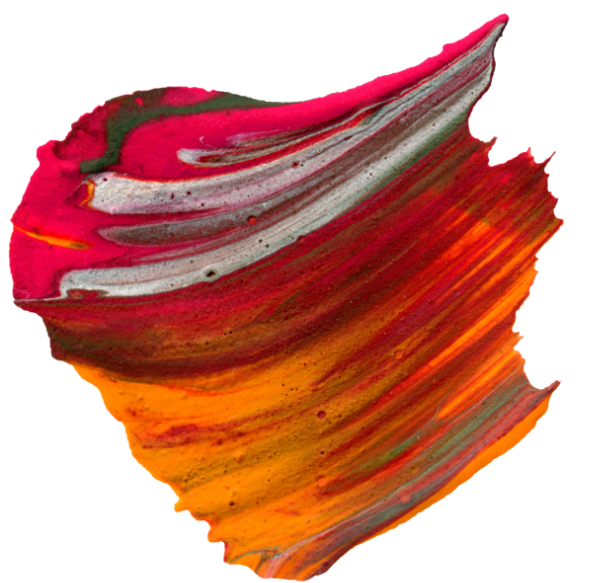
Michel Huelin's entry into the art world was marked from the outset by a radicality unusual in the Swiss context of the time. From the mid-1980s, while still a student, he produced works that can be reduced neither to paintings nor to sculptures: support-free paintings, obtained by successively layering acrylic, vinyl and synthetic paint poured onto plastic sheets. Once hardened, this material was peeled away to become an autonomous slab — a self-supporting pigment skin, freed from the stretcher and the wall.

These surfaces, known as slabs, were folded, cut, laid on the floor or hung in space. Painting was no longer a window onto the world: it was a physical presence in space, a material entity with its strata, its thickness, its memory. Gravity played a determining role — the lower layers remained invisible unless the work was broken, revealing a hidden depth. Colour ceased to be applied: it was deposited, thickened, it became body.

This approach engaged with international postmodern debates on the deconstruction of the pictorial medium, yet distinguished itself through a particular attention to physical density and chromatic stratification. This was not a minimal conceptual gesture: it was an organic investigation of matter. Painting was already conceived as environment rather than image.

Recognition came immediately. In 1986, while still a student, Huelin was invited to exhibit at the Kunsthalle Bern as part of the exhibition Von Bildern. He would return there in 1987, and received the Federal Fine Arts Grant (Kiefer-Hablitzel Foundation) twice, in 1987 and 1988. He also exhibited in New York, India, Geneva and Zurich. These early years established the constants that would run through the entire body of work: the importance of chance, attention to stratification, material autonomy, and the physical relationship to the floor and space.


The Mirror Image and Domestic Asepsis (1993-2000)

In the early 1990s, Huelin made a decisive shift: he returned to the canvas format, but invented a personal technique that would become one of his most recognisable signatures. On rigid supports — aluminium, wood, PVC — he applied alkyd resins that produced surfaces of extreme smoothness, brilliant and quasi-industrial. No gestural trace is visible. The brushstroke disappears. The surface appears to have emerged from a manufacturing process rather than an artist's studio — it evokes ceramic tiles, plexiglas, automotive bodywork.

What he painted at this time were domestic interiors: unmade beds, sofas, cushions, tiled floors, everyday objects drawn from catalogues, treated with a precision close to computer-generated imagery. The human figure is absent from the representation, yet suggested by a fold, a swelling, a trace left on objects. The chromatic reduction — often two contrasting tones, a duotone — accentuates the stylisation and gives these spaces a silent strangeness, suspended between presence and disappearance.

The mirror effect of the alkyd surfaces radically altered the relationship between the work and the viewer. The visitor's reflection appeared in the image. Real space inscribed itself within the painting. A perceptual instability took hold: illusionistic depth and reflective plane coexisted; the image absorbed reality; the viewer's body became part of the composition, yet in a fragile, spectral form. This was not merely an aesthetic device — it was a critical apparatus interrogating the spectator's position in a world saturated with images. In this way, Huelin anticipated, through pictorial matter, the problematic of the screen: brilliant surface, integration of the gaze, superimposition of spaces.

This original technique constitutes a major contribution to Swiss painting of the 1990s. Exhibitions at the MAMCO in Geneva (1996), the Centre Culturel Suisse in Paris (1999), as well as participation in Art Basel and the FIAC, testify to growing recognition both in Switzerland and internationally.


The Fire and the Digital Turn (2001)

In 2001, a criminal fire destroyed his Geneva studio on the Avenue de Rosemont, along with more than a hundred works. Three years of work reduced to nothing. This traumatic event constitutes a pivotal moment in his career — not a rupture, but an intensification and reorientation. The computer, which had until then served as a preparatory tool, became a central instrument of creation. This transition did not represent an abandonment of painting, but a shift in the centre of gravity of the creative process towards a new territory of experimentation.


Virtual Biotopes and Hybridisation (2003-2015)

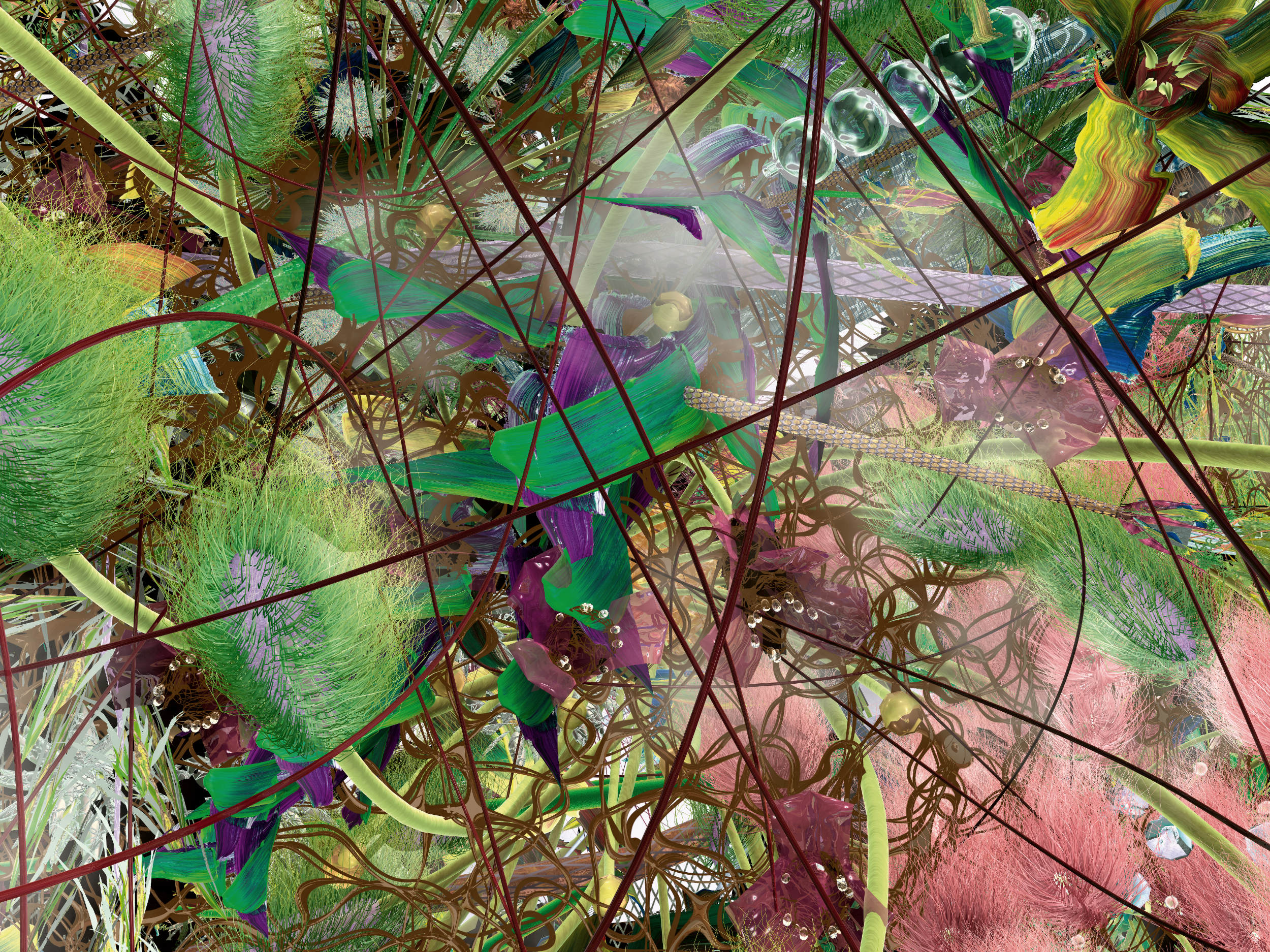
From 2003 onwards, Michel Huelin developed worlds generated by 3D modelling and generative computation. He explored phenomena of proliferation, hybridisation and algorithmic growth, producing forms in which the vegetable, animal and artificial intermingled — virtual biotopes whose strangeness oscillated between fascination and unease.

The monumental installation Diversity (2003), created for the University of Geneva (Sciences III), functioned as an allegory of the chain of life, drawing on references to DNA, biodiversity and complex biological forms. Then came Xenobiosis (2006), presented at the Abbatiale de Bellelay: Huelin transformed the baroque space of the church into a virtual greenhouse, installing mirrors on the floor to create bottomless wells and disorient the viewer. The eponymous video, looping at 7 minutes 15 seconds, staged hybrid organisms on the borders of the vegetable, the mineral and the artificial. Critics spoke of a "deceptive world", a tension between seduction and danger, the figure of the sorcerer's apprentice.

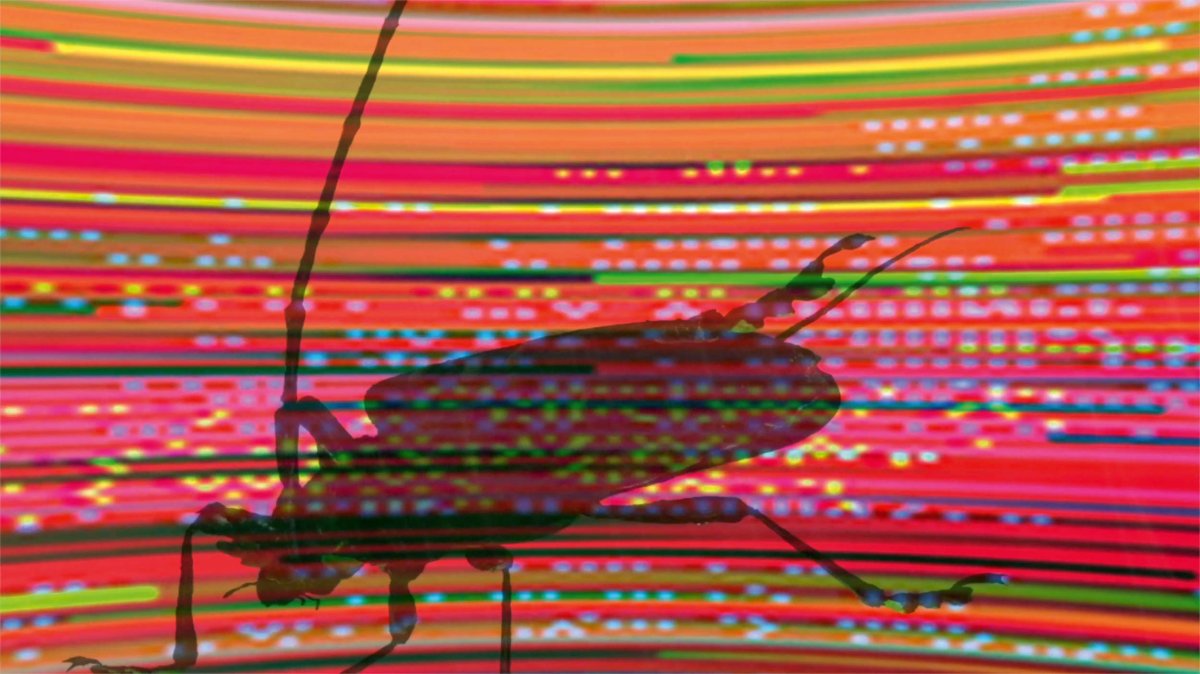
His approach was not illustrative but structural. Passionate about biology, complex systems and evolution, Huelin worked with parameters, accepted randomness, allowed unpredictable forms to emerge. The computer bug became a method, the calculation error a creative engine — just as accidents of matter had been in the early support-free paintings. A parametric system functions like an evolutionary system — variation, selection, mutation, drift — and the artist becomes a selector.

Throughout this period, he maintained two studios: one in Lausanne for digital modelling, the other in Geneva for painting. Images often originated on screen before being transposed into painting through fine superimposed layers of acrylic. Conversely, he scanned painterly drips and reinjected them into his digital compositions. This circulation between matter and pixel — what he himself called "the marriage of brush and mouse" — constitutes one of the most innovative aspects of his work: not illustrating the virtual, but placing in crisis the boundary between material image and calculated image.

Exhibitions multiplied: Uncontrolled Growth (New York, 2008 and 2009), Phytotron (Zurich, 2009), Alkyd & Pixels (Geneva and Paris, 2010-2011), Landscape Recovery (Paris, 2016). He participated in numerous international art fairs — FIAC, Art Brussels, Pulse Art Fair New York and Miami, Art Forum Berlin — represented principally by Galerie Zurcher in Paris and Blancpain Art Contemporain in Geneva.


Ecology, Precarious Architectures and Artificial Intelligence (2016-2025)

Huelin's most recent works radicalise his position along political and ecological lines. Influenced by Timothy Morton's thinking around dark ecology, he depicted fragile habitats, ruined structures and cabins, houses drawn as if by children whose outlines are made of coloured adhesive tape — a banal and discreet medium that amplifies precisely the fragility of the proposition. The ecosystem is precarious; the world potentially uninhabitable.

From 2023, he integrated artificial intelligence as a generative tool — not as a substitute for the artist, but as a creative partner capable of propositions to which the human eye reacts, orients and reframes. The work Dans ma chambre (2023) illustrates this: an image generated by AI depicting a tiled room in which ruined buildings are piled in a corner, with a mirror that does not reflect the scene and a portrait of the Earth replacing the crucifix on the wall — an interior Tower of Babel, charged with ambiguity.

This integration of AI extends an established logic: from the drips of the earliest paintings to the bugs of 3D modelling, chance and accident have always been creative engines in Huelin's work. AI is not a rupture — it is the contemporary version of the same interrogation into the limits of control and the role of the unpredictable in creation.

The exhibition Habitable?, presented at the Musee jurassien des Arts in Moutier in 2025, synthesised these investigations: fragile houses, minimalist shelters, empty spaces, architectural deconstruction, a dialogue between earlier and recent works. Valentine Reymond, the museum's director who had first invited Huelin in 1999 for his very first exhibition in that space, chose for her final season at the helm to invite him once again — a return charged with meaning, a symbolic loop.


A Work in Tension: Transversal Principles

Across four decades of practice, Michel Huelin's work is characterised by a deep coherence, structured around a few permanent axes.

The tension between materiality and virtuality is primary: from the earliest support-free paintings to 3D modellings transposed onto canvas, he has never ceased to question the skin of the image and its physical presence in space. Painting remains in his work the site of incarnation, giving it a strong museological grounding in an era of dematerialisation.

The hybridisation of nature and artifice is equally central: his work blurs the boundaries between the vegetable, the animal and the technological, creating ecosystems in which the natural appears artificial and vice versa. This curiosity for biology, evolution and complex systems is not illustrative but structural — it organises the creative process as much as the forms produced.

The primacy of the gaze runs throughout: whether through the mirror effect of alkyd surfaces or through digital immersive devices, Huelin always places the viewer and their movement at the heart of the work. The viewer is physically integrated into the composition, yet in a destabilising, spectral manner.

Finally, a constant critical stance towards technology and its ethical implications — genetic manipulation, the overproduction of images, the virtualisation of human relations, artificial intelligence — runs through the entire body of work, without ever yielding either to technophobia or naive enthusiasm.

Michel Huelin remains, fundamentally, a painter. Even when working with the computer, 3D modelling or artificial intelligence, painting remains the foundation of his thinking and the point of return for all his explorations. His work constitutes today an essential landmark for understanding the evolution of Swiss painting between postmodern materiality and the algorithmic era — and one of the most rigorous demonstrations that these two regimes of images need not oppose one another, but can interpenetrate to the point of revealing what one conceals from the other.

(Alkyd&Pixel, 2026)

Recherche